
Swimming During the Haze in Singapore
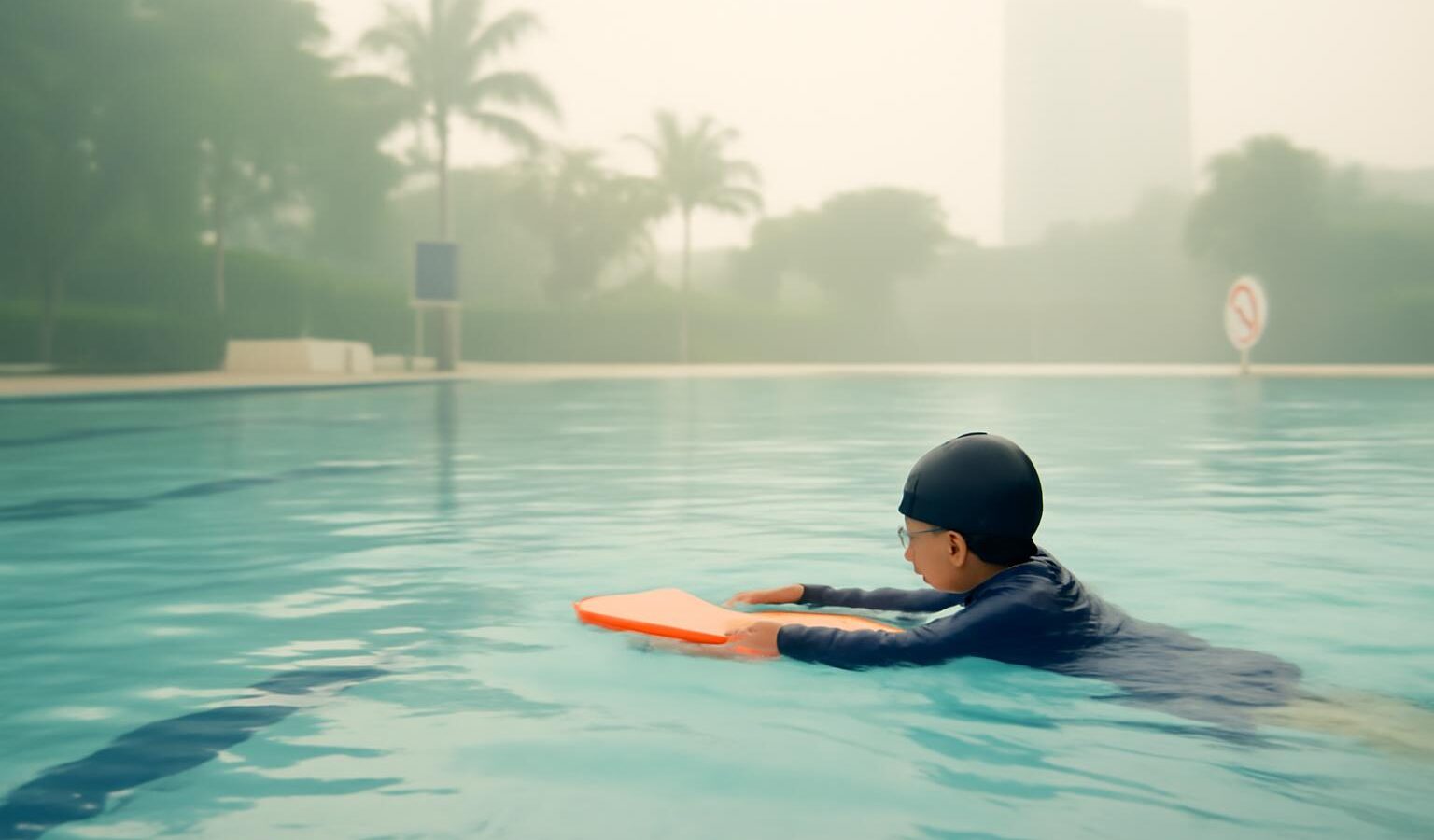
Swimming during haze in Singapore is a question almost every parent and adult learner asks when the skies turn grey and the air smells smoky — and the honest answer is that it depends on the air quality readings and the advice of the authorities on the day.
The transboundary haze that occasionally drifts across the region can push Singapore’s air quality readings up sharply within hours. Because swimming is moderate to vigorous exercise that makes you breathe harder and deeper, it is sensible to be cautious about being active outdoors when the air is poor. This guide explains how to think about swimming during the haze, how to read the official readings, and how to make a sensible call for yourself or your child.
First, a note on who we are: SwimSafer (swimsafer.sg) is an independent private swim school. We coach and prepare students for the national SwimSafer syllabus, but we are not the official programme and are not affiliated with SportSG, Singapore Aquatics or the National Water Safety Council. Our head coach, Coach U.K. (Umesh “U.K.” Singh), is an AUSTSWIM-accredited swim teacher and certified Singapore Armed Forces life-saver who has coached since 1999.
How haze affects exercise like swimming
Haze is made up of fine particles that can irritate the eyes, nose, throat and airways. When you swim, you breathe more deeply than at rest, so you draw more of those particles in. For most healthy people a short, light swim in mildly hazy conditions is unlikely to cause lasting harm, but it can still bring on coughing, a scratchy throat or watery eyes. For young children, older adults, pregnant women and anyone with asthma or other heart or lung conditions, the effects can be more pronounced and appear sooner.
Because outdoor and many condo and public pools are open-air, the air around the pool is essentially the same as the outdoor air. An indoor pool with good ventilation or filtration may be more comfortable, but it is not a guaranteed shield, so the same caution applies.
Follow the official NEA advisories
The single most important habit during a haze episode is to follow the official advice rather than guessing. The National Environment Agency (NEA) publishes the Pollutant Standards Index (PSI) and the 1-hour PM2.5 readings, and updates health advisories for the general public and for vulnerable groups. These are the figures to check before heading to the pool.
- Check the latest readings. Look at NEA’s 24-hour PSI and the 1-hour PM2.5 concentration band for your region (north, south, east, west or central) close to the time you plan to swim.
- Read the health advisory, not just the number. NEA pairs each band with advice on whether to reduce or avoid prolonged or strenuous outdoor activity, and gives separate guidance for vulnerable people.
- Remember haze changes quickly. Readings can rise or fall within an hour as wind shifts, so a check from the morning may be out of date by the afternoon.
Because official thresholds and advice can be updated, always defer to the current NEA guidance on the day rather than to any fixed rule of thumb you may have read in the past.
Follow your pool operator’s rules
Public pools, condominiums and schools often have their own policies for hazy conditions. ActiveSG and town councils may close or limit the use of outdoor facilities when air quality is poor, and lifeguards or facility staff make the final call at each venue. If the operator decides to close the pool or suspend activities, respect that decision — they are acting on the same advisories and on their duty of care.
As a private swim school, we take the same approach. Whether your lessons are at your own condominium, landed-home or private pool with Coach U.K., or at a public swimming complex with a certified coach from our network, the rule is the same: when the air quality is poor enough that strenuous outdoor activity is discouraged — or the pool operator or your condo’s management closes the pool — we will reschedule rather than push ahead. No single session is worth a child’s comfort or health, and we would always rather move a class than have a young swimmer cough through it.
A sensible way to decide
Rather than a rigid cut-off, use a simple checklist before any swim during a haze episode:
- Is the air quality in a healthy band per NEA? If the advisory recommends reducing or avoiding strenuous outdoor activity, it is wise to postpone.
- Who is swimming? Be more cautious for young children, older adults, and anyone with asthma or a heart or lung condition.
- How hard and how long? A gentle 20-minute splash is different from a long, intense training session. Keep it shorter and lighter if you do go.
- How does it feel? If you can see or smell heavy haze, or anyone develops a cough, sore throat or watery eyes, get out and head indoors.
- What does the pool operator say? If the facility is closed or has suspended activity, that decision stands.
If you skip the pool
A cancelled swim during the haze is not a wasted day. Children can keep their water confidence ticking over with dry-land practice such as breathing rhythm, arm-stroke shapes and gentle stretching at home, and you can use the time to talk through water-safety ideas. The skills return quickly once the air clears and lessons resume. If you have booked a private lesson with us, we will simply find another slot.
Frequently asked questions
Is it safe to swim when it is hazy in Singapore?
It depends on the air quality on the day. For a short, light swim in only mildly hazy conditions, most healthy people will be fine, but when NEA’s advisory recommends reducing or avoiding prolonged or strenuous outdoor activity, it is better to postpone. Always check the current PSI and PM2.5 readings and the accompanying health advice first.
What PSI level is too high for swimming?
There is no single magic number, and official thresholds and advice can be updated, so we do not quote a fixed figure. The right approach is to read NEA’s current health advisory for the relevant band and follow its guidance for the general public and for vulnerable groups, alongside your pool operator’s rules.
Is an indoor pool safer than an outdoor pool during haze?
An indoor pool with good ventilation or filtration may be more comfortable than an open-air pool, but it is not a guaranteed shield against fine particles. Treat it with the same caution and follow the venue’s policy.
Can children with asthma swim during the haze?
Children and adults with asthma or other respiratory conditions are more sensitive to haze and should be especially careful. Many will be better off staying indoors when air quality is poor. Follow your doctor’s advice and the NEA guidance for vulnerable groups.
Will my swimming lesson go ahead if it is hazy?
If the air quality is poor enough that strenuous outdoor activity is discouraged, or the pool operator closes the facility, we will reschedule the lesson rather than proceed. Your child’s comfort and health come first, and we will find another slot once conditions improve.
My child missed lessons because of the haze — will they fall behind?
A few postponed sessions rarely set a learner back for long. Water confidence and skills come back quickly once lessons resume, and we adjust the pace to each child. A little dry-land practice at home in the meantime helps keep the rhythm.
Have questions about swimming safely in Singapore’s weather?
If you would like guidance on lessons that work around the haze and our changeable weather, WhatsApp Coach U.K. on +65 9021 1254. You may also find our kids swimming lessons, water survival and life-saving skills and contact pages helpful for planning around the weather.