
Adult Beginner Swimming: A Complete Guide
This adult beginner swimming guide walks you through exactly what to learn, in what order, and how to practise safely — from your very first bubble to your first relaxed length of freestyle. Whether you have never swum a stroke or you “kind of” splash to stay afloat, the right sequence makes all the difference.
Plenty of adults in Singapore can technically survive a fall into water but have never been taught to swim properly. The result is tense, exhausting, head-up paddling that feels nothing like the smooth swimming you see others doing. The good news is that proper technique is learnable at any age, and it is far easier than thrashing. This guide explains the building blocks; an in-person coach turns them into real skill.
Before you start: mindset and safety
Swimming rewards relaxation, not strength. The harder you fight the water, the more it fights back. Approach every session calm and patient, and remember three safety rules that never change:
- Always practise in a pool with a lifeguard or qualified coach present.
- Stay in water where you can comfortably stand until your floating and breathing are reliable.
- Never test deep water alone — survival skills first, distance later.
The five core skills, in order
1. Breathing and bubbles
Everything begins with breath. Standing in shallow water, take a normal breath, lower your face in, and breathe out slowly and continuously through your nose and mouth, making a steady stream of bubbles. Lift your face, breathe in, repeat. This single habit — exhaling underwater instead of holding your breath — prevents panic, keeps water out of your nose, and underpins every stroke you will ever swim.
2. Floating
Learn to float on your front (the “starfish” or “jellyfish” float) and, crucially, on your back. With full lungs and a relaxed body, the water holds you up. The back float is a survival skill: if you ever tire, you can roll onto your back, breathe and rest. Keep your head back, ears in the water, hips up and body soft. Tension is the enemy of floating.
3. Gliding and streamline
Push gently off the wall or pool floor with arms extended past your head, one hand over the other, and glide like a torpedo. The lesson here is body position: head down between your arms, hips high, body long and flat. Good streamline means you travel far for little effort and sets up every stroke that follows.
4. Kicking
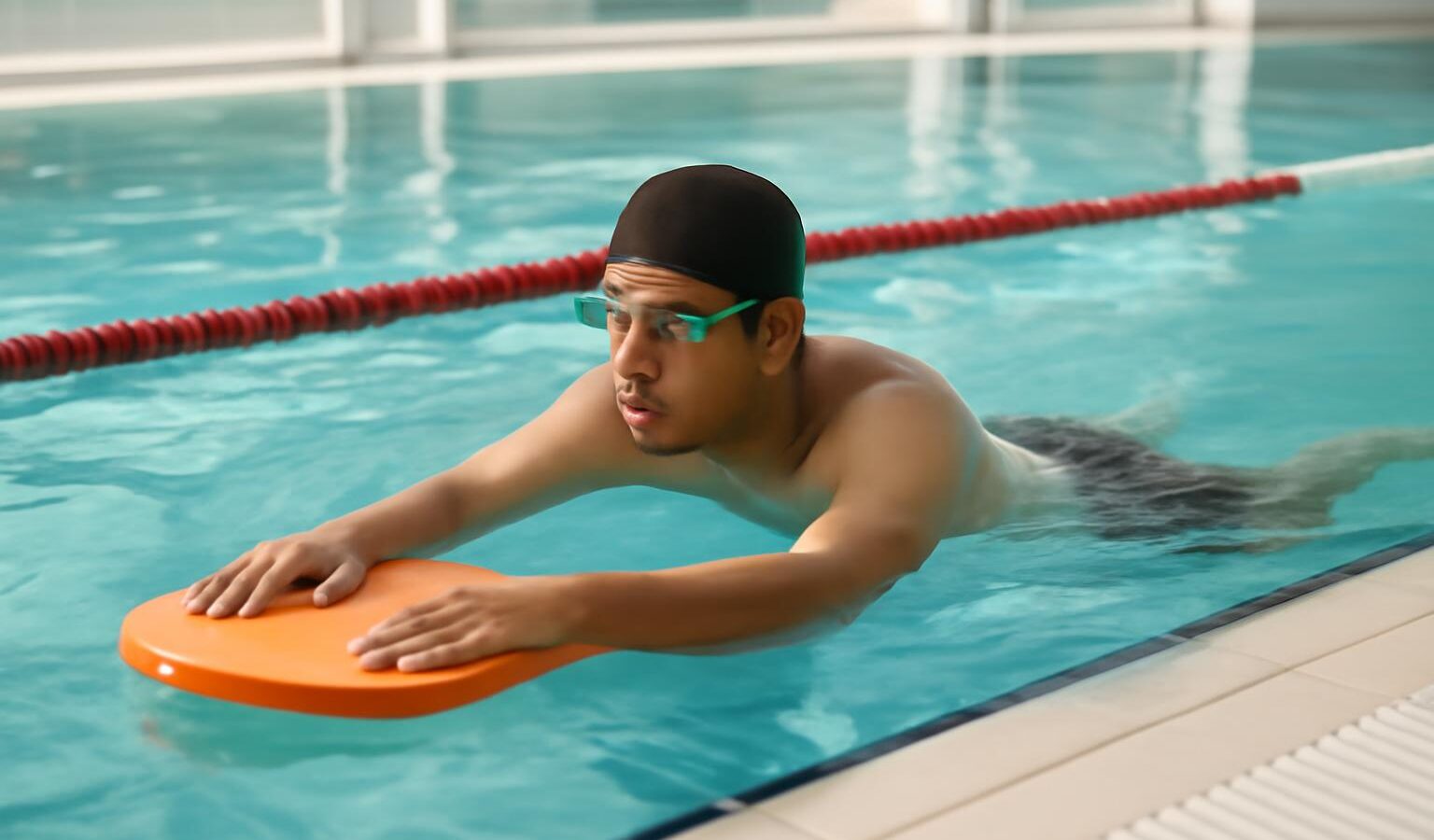
Add a flutter kick from the hips — long legs, loose ankles, small fast kicks rather than big bent-knee stamps. Practise with a kickboard so you can focus on the legs and breathing. The kick provides balance and a steady push, not raw speed.
5. Arms and breathing together (freestyle)
Finally, layer in the arm action: reach forward, catch the water, and pull back past your hip, alternating arms. To breathe, turn your head to the side in time with one arm — keeping one ear in the water — rather than lifting it forward. Coordinating the pull, the kick and rhythmic side-breathing is the part most adults need a coach’s eyes for, because small timing errors are hard to feel yourself.
Don’t skip treading water
Treading water lets you stay upright and breathe in deep water. Using a gentle scissor kick or an eggbeater (alternating circular leg action) with relaxed sculling hand movements, you keep your head above the surface without moving anywhere. It is one of the most important survival skills an adult can own, and it builds confidence to venture into deeper water safely.
How to practise between lessons
- Quality over quantity: 20–30 focused minutes beats an exhausting hour of bad habits.
- One thing at a time: dedicate a session to bubbles, another to floating, another to kicking.
- Film yourself (where pool rules allow) so your coach can review your body position.
- Rest and breathe whenever you feel tense — calm is a skill you are training too.
Why a coach speeds everything up
You can read every guide online and still struggle, because you cannot see your own body position or feel your own timing errors. A coach gives instant, specific correction, keeps you safe as you progress into deeper water, and adjusts the plan to your fears and your pace. Real, dependable progress comes from consistent in-person coaching — guides like this one point you in the right direction, but a qualified teacher gets you there far faster and far more safely.
Frequently asked questions
How long before I can swim freestyle?
It varies with your starting confidence and how often you practise. Many adults swim a short, controlled freestyle within a few weeks of regular lessons, with a relaxed full length following once breathing and body position become automatic. Treat any timeline as approximate.
What should I bring to my first lesson?
A well-fitting swimsuit, goggles and a swim cap if the pool requires one. Comfortable goggles in particular make a huge difference to a beginner’s confidence because you can see clearly underwater.
I sink as soon as I try to float. Why?
Almost always tension and holding your breath. A relaxed body with full lungs floats; a stiff body that exhales sinks. Lighter, leaner builds may float lower, which is normal — a coach will teach you small adjustments so you can still rest and breathe.
Is freestyle the best first stroke to learn?
For many adults, yes, because its building blocks (streamline, flutter kick, rhythmic breathing) transfer well. Some prefer to start with breaststroke for the head-up comfort. A coach will recommend what suits your body and confidence.
Can I learn at a condo or home pool?
Yes — and you have two options. Coach U.K. teaches private lessons at your own condominium, landed-home or other private pool island-wide, travelling to you, which most adults find far more relaxing and discreet for those early sessions. If you would rather learn at a public swimming complex, we can pair you with a certified, NROC-registered coach from our island-wide network at a pool near you. If you go on to take a SwimSafer assessment, that is conducted by certified assessors, usually arranged at a public pool when you are ready.
Does this prepare me for the SwimSafer skills?
These foundations align with the water competency the SwimSafer syllabus develops. We are an independent swim school that coaches and prepares students for the SwimSafer syllabus — please confirm current requirements with the official SwimSafer syllabus and Singapore Aquatics, as criteria can change.
Ready to start swimming?
Bring this guide to life with proper, patient coaching. Message Coach U.K. on WhatsApp at +65 9021 1254 to arrange your first adult beginner lesson. An AUSTSWIM-accredited teacher and certified life-saver coaching since 1999, he will pace everything to you and keep you safe at every step. See our adult swimming lessons, our support for nervous beginners, our water survival skills, and indicative rates on the pricing page.